
Two reports sit on the desk of every infrastructure hiring manager this year, whether they have read them or not. Infrastructure Australia's 2025 Infrastructure Market Capacity Report covers the national picture. Construction Skills Queensland's Horizon 2032 covers the state with the steepest ramp. I recruit the engineers and project leaders both reports say are short, so here is what the numbers look like from the hiring side.
The pipeline turned up, not down
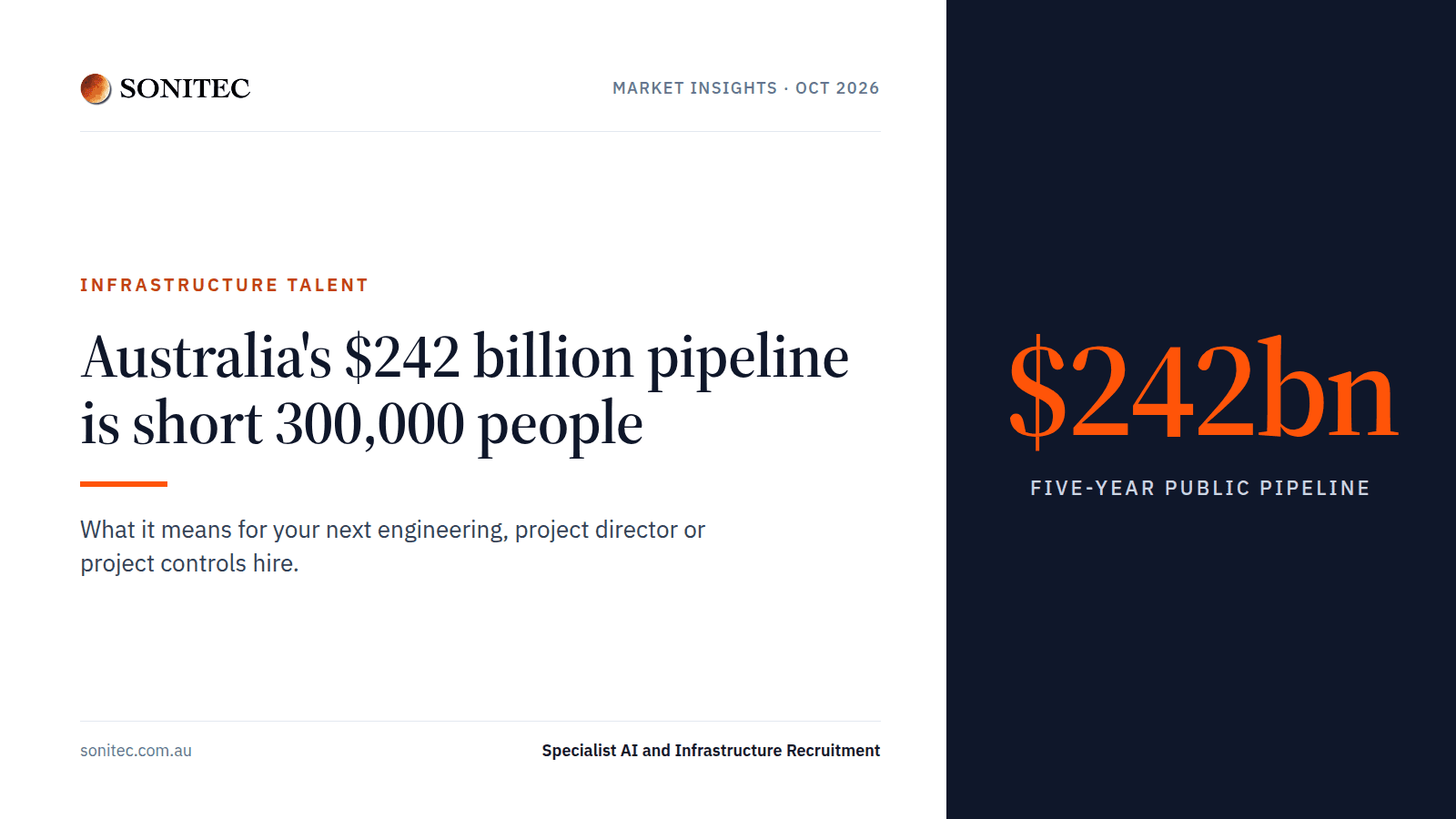
Infrastructure Australia puts the five-year Major Public Infrastructure Pipeline at $242 billion for 2024–25 to 2028–29, up 14% on the outlook it published a year earlier. That is the first increase since 2022 and the highest figure since the series began. Transport is still the biggest line at $129 billion, or 53% of the pipeline, and it is steady rather than growing. The growth is elsewhere: buildings at $77 billion, driven by social housing and health, and utilities at $36 billion, up $20 billion in a year, almost all of it new transmission lines.
The private pipeline is not in that number. The report's own survey work says energy projects are being delayed at the approvals stage, and that firms are holding off on workforce investment until they see shovels in the ground. Data centres are not a public pipeline item either, but Infrastructure Australia names them, alongside energy, defence and water, as a sector where shortages of engineers, designers and experienced project directors are constraining what gets delivered.
The workforce is the constraint
The report calls labour the most critical delivery risk, and around 60% of the firms it surveyed agree. Australia's infrastructure construction workforce stands at 204,000 people. The projected shortage is 300,000 workers by 2027, a new high, after a brief easing in 2024. Regional shortages are forecast to quadruple between 2025 and 2027 on the back of energy projects.
Two numbers in that forecast matter more than the headline if you hire professionals rather than trades. The shortage of engineers, scientists and architects peaks at about 126,000 in late 2026. The shortage of project management professionals peaks at about 59,000 in mid-2027. Those are the people who run commissioning programmes, grid connections, venue builds and rail packages. The report also notes that engineers and designers are now stretched across energy, water and commercial construction at the same time as transport demand holds steady.
One more structural point. Subcontracting now accounts for 41% of infrastructure construction, which means more than $100 billion of the five-year pipeline will be delivered by firms other than the principal contractor. Tier 2 and specialist contractors are competing for the same project directors, engineering managers and commercial managers as the Tier 1s, and often paying for them.
Queensland is the steepest ramp
Horizon 2032 forecasts Queensland's construction pipeline rising from $53 billion in 2024–25 to $77 billion in 2026–27, a 50% increase in two years. Workforce demand peaks at 156,000 construction workers in 2026–27, and CSQ expects an average shortfall of 18,200 workers across the eight years to 2032, with a peak of about 50,000 in 2026–27. The drivers are population growth, the energy transition, and the venue, transport and precinct programme ahead of 2032.
The engineering side of that pipeline was $22.1 billion of work yet to be done at June 2024, 68% of it public, concentrated in water, rail and bridges, electricity and roads. That is the work that pulls project engineers, planners and contract administrators out of Sydney and Melbourne, and it is one reason the published Queensland bands for Tier 1 construction managers and senior estimators now sit at or above New South Wales in our 2026 salary bands.
What this means if you are hiring
- The same engineer has four bidders. A project engineer with HV or grid connection experience is wanted by a transmission contractor, a data centre operator, a transport alliance and a water utility in the same month. Randstad's 2026 Engineering & Construction report names mechanical services estimators, critical facilities managers and building services engineers as the roles the Sydney and Melbourne data centre build-out is pulling on hardest. A brief that reads like every other brief will not get a reply.
- The peaks are 2026 and 2027, so the hiring is now. Engineers are shortest in late 2026 and project managers in mid-2027. A search started in the quarter the role becomes critical is a search run at the worst point of the cycle.
- “Wait and see” is a gift to whoever moves first. Infrastructure Australia reports that many firms are relying on redeploying people from adjacent sectors rather than committing to long-term workforce investment. The firms that confirm a role and run a proper search now are hiring against competitors who have not yet started.
- Screen for transferability, not just the badge. If the market is going to redeploy people across sectors anyway, the question is which commissioning engineer from a hospital or a substation can step onto a data hall, and which cannot. That is a screening question about systems, site types and scope, not a question of whether the right employer name is on the CV.
- Queensland and New South Wales are now one market for senior people. With Queensland bands at or above New South Wales for several delivery roles, a Sydney project director is a relocation conversation away from a South East Queensland package. Plan for it in the offer, not after the counter-offer.
How we use these reports
We do not quote these numbers to make a sale. We use them to set expectations honestly. The figures above feed the market context on our Infrastructure Talent page and the sources listed with our salary bands, and we re-check the bands against live job ads before we change them. Tell us about the role and we come back with a search plan. A first shortlist takes at least 15 business days.
Sources: Infrastructure Australia, 2025 Infrastructure Market Capacity Report (November 2025); Construction Skills Queensland, Horizon 2032, 2025 edition; Randstad Australia, Engineering & Construction Salary Report 2026. Figures are as published; salary bands are AUD base, excluding superannuation.